
By July 1989, the work of the 10-man committee tasked by the PNDC government to establish the Ghana Stock Exchange had borne fruit. About 16 months thereafter, trading commenced. Three decades later, Ghana’s public securities market has mixed stories to report. As critics like to point out, having fewer than 100 listed equities is hardly an achievement to trumpet. But what the critics overlook is the opportunity the GSE has afforded private companies (including Letshego, Bayport and Dalex) to issue debt securities, thereby raising a total of GH¢975,547,754 (data valid as at FY 2020) from domestic and foreign investors. This obviously has helped to expand output, create jobs and increase tax receipts for the government.
Over the years, the GSE Composite index has demonstrated correlation with growth trends in the real sector, with trade volumes rising and falling as the economy did its ‘see-saw-up-and-down’. Take 2010 for instance, after growth rebounded from a prior year fiscal performance of 4.8% to 7.9% in 2010, average daily trade (volume) also increased from 395,024 in 2009 to 1,346,345 in 2010, a 241% growth. A close look at the data trends reveals similar patterns in 2016-2017 when economic growth rebounded from a prior year slump. Despite this, many investors, particularly on the retail end of the market, find investment in equities rather uninviting, as compared to alternative securities that are more liquid and offer competitive yields. To make matters worse, the disruptive phase of the regulatory reforms in the sector has battered investor confidence, even though the same is expected to rebound when stability returns.
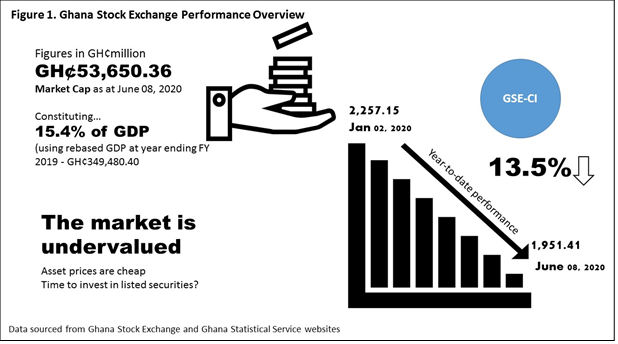
As expected, the confluence of several factors, including COVID-19, harmed the revenue performance of some Licensed Dealing Members. The struggle for survival has undoubtedly had a Darwinian impact on competition in the investment banking space, with some rebranding to shed their old ‘skin’. Titans such as Strategic African Securities Limited and Databank continue to lead the pack in securities transactions across public and private markets while rising stars like IC Securities extend their footprint, sponsoring heavyweights such as MTN and Tullow. Old guards like UMB Stockbrokers continue to stake their claim as being not just the oldest, but having sponsored some of the big ticket public offerings such as AngloGold Ashanti, Accra Brewery Limited, PZ Cussons and Enterprise Insurance, just to name a few. With CAL Brokers’ exit from the securities business, new concerns have emerged about how robust the balance sheet of broker-dealers is, and whether investment banks are in a position to ride out the trough until the economy rebounds..